Healthcare professionals

Indicated for the treatment of mild or moderate ulcerative colitis in active phase, as add-on therapy to 5-ASA containing drugs in patients who are non-responders to 5-ASA therapy in active phase.1
Keep it simple
When aminosalicylates (5-ASAs) alone are not enough to induce remission, consider adding Clipper1,2
- Non-inferior to prednisolone in the treatment of active UC (given as a prodrug – prednisone)3,4
- Limited systemic steroidal adverse events5
- Simple to take

Ulcerative colitis

The management of UC flares presents a significant challenge for healthcare professionals and their patients. 70% of those with active disease and 30% of those in remission in a given year will experience a flare the following year.9 Flare symptoms and severity vary from person to person and may last from a few days to several months.10
For patients that do not respond to up titrations of aminosalicylate therapy, further treatment with topical or oral corticosteroids for 4–8 weeks (depending on steroid), is recommended.11

Gastroenterology backlog prevents ease of seeing a specialist
392,574
gastroenterology appointments
23,473 (6%)
patients
1+ year
waiting for an appointment12

Due to the high number of patients experiencing flares, access to hospital-based specialists is under huge pressure, making it vital that referral from primary care is only for patients that need to see a gastroenterologist.
There is currently a backlog of gastroenterology appointments (September 2023) with 23,473 (6%) of patients waiting more than a year for an appointment.12
Improving access to Clipper® in primary care
Any reduction in outpatient appointments and secondary care admissions for patients with flares could release capacity, keep care closer to home, help to improve the whole system flow, and contribute to delivering a balanced net financial position as aligned with National Health Service objectives.12,13
The addition of Clipper® to repeat prescriptions of appropriate patients will allow patients to easily access and self-administer the medication in a home setting14 minimising the requirement for outpatient attendance to obtain repeat prescriptions of Clipper® for each subsequent flare.
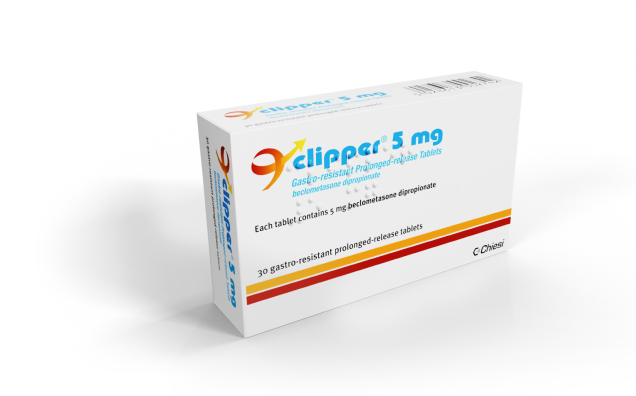

Keep it Simple
For managing flare ups in mild to moderate ulcerative colitis when 5-ASAs alone are not enough to induce remission1,2

Effective
Clipper is non-inferior to prednisolone (given as a prodrug – prednisone) in the treatment of active mild to moderate ulcerative colitis3,4

Topical steroid
side effect profile
Clipper has low systemic
bioavailability and therefore a more favourable side effect profile compared with
conventional steroids1,6

Simple
One tablet, once a day for up to 4 weeks, with no titration1
Need to know more?

Co-Primary Endpoint – Efficacy of Clipper 3,4
Clipper is non-inferior to prednisolone (given as a prodrug – prednisone) in improving:

Clinical symptoms
Endoscopic healing
Rectal bleeding
The percentage of patients in remission were similar between the two groups.

Non-inferiority of Clipper vs. PD was confirmed as the difference between the two treatment groups as −1.56 with a 95% CI of −13.00–9.88 (P= 0.78, ITT population).
Similar results were observed in the PP population.

Abbreviations
DAI; disease activity indicator, ITT; intention to treat, PD; Prednisone, PP; per protocol.
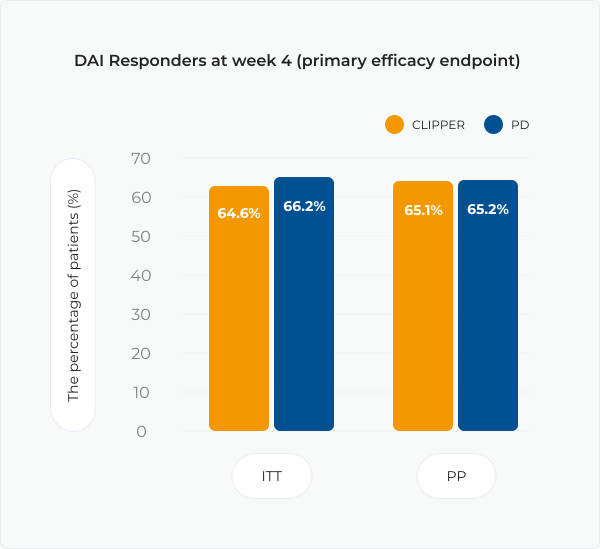
Graph adapted from Van Assche et al.


Study design:
Double-blind study comparing efficacy and safety of the topically acting corticosteroid beclomethasone dipropionate to prednisone in patients with active, mild-to-moderate ulcerative colitis. METHODS: Overall, 282 patients were randomized to receive Clipper prolonged release tablets 5 mg once daily for 4 weeks and then every other day for an additional 4 weeks or oral PD 40 mg once daily for the initial 2 weeks tapered of 10 mg every 2 weeks during the 8-week study period.3
Co-Primary Endpoint – Safety of Clipper3
The primary safety endpoint was to demonstrate a safety profile versus prednisone in terms of patients who experienced steroid-related AEs and reduction of endogenous cortisol production <150 nmol/l.

The study did not meet the
co-primary safety endpoint.

Treatment difference
(Clipper-PD): -8.21.
95%CI: -19.72 to 3.30.
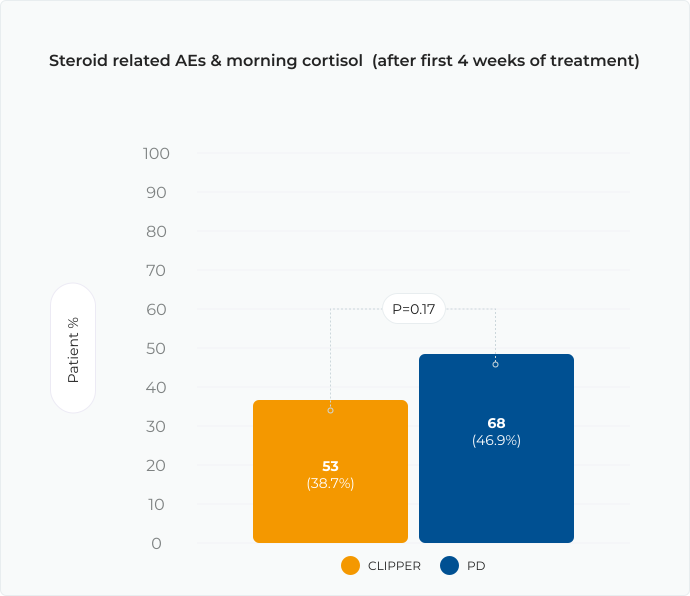
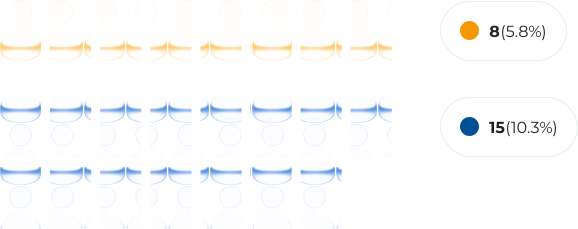
A total of 28 steroid-related AEs (10 in the Clipper and 18 in the PD group), were reported in 23 patients in the first 4 weeks of the treatment period, of which 8 patients (5.8%) were in the Clipper group and 15 (10.3%) were in the PD group (P=0.18).

Regarding morning serum cortisol, a total of 50 (37.9%) patients in the Clipper group and 62 (44.0%) patients in the PD group had levels <150 nmol/l (P =0.31) at the end of 4 weeks of treatment.
Abbreviations
AEs; adverse events, PD; Prednisone
As Clipper is gastro-resistant prolonged released and used for up to 4 weeks, it offers efficacy with a low potential for systemic consequences1,5,8
In vivo disintegration visualisation for an enteric coated modified release beclomethasone dipropionate delivery system

28 minutes
Passage through the stomach
117 minutes
Clipper remains intact for 57-118 min
253 minutes
Entering the colon
379 minutes
Dissolution ending

Gamma scintigraphy data in healthy volunteers demonstrated that Clipper remains intact for 57-118 minutes before initial disintegration begins.
Clipper dissolution process over time (scintigraphic data). Adapted from International Journal of Pharmaceutics 1994;112:199-205
Posology of Clipper1

Adults
- One Clipper 5 mg tablet a day to be taken in the morning before or after a light breakfast.
- Tablets must be swallowed whole with a little liquid. The tablets should not be broken or chewed.
- Therapy cycles of not more than 4 weeks are recommended.

No special dose adjustment is recommended. However, experience with Clipper in the elderly is limited.

Clipper is not recommended
for use in children.
Refer to the SmPC for further information


Download our resources


Would you like to be notified when further resources
become available?
Contact Us
We’re here to help!
Whether you have questions about our services, need assistance with a product, or simply want to share your feedback, our dedicated teams are ready to assist you.
Please reach out to us using the contact information below, and we’ll get back to you as soon as possible.

Medical enquiries

Sales enquires

Something else?
Contact our UK head office

Chiesi Limited, 333 Styal Road, Manchester, M22 5LG, United Kingdom

info@chiesi.uk.com

+44 (0)161 488 5555

+44 (0)161 488 5566

References
- Clipper Summary of Product Characteristics, https://www.medicines.org.uk/emc/product/6417/smpc Accessed May 2024.
- UC Flare Pathway; IBD UK; https://ibduk.org/ibd-standards/flare-management/flare-pathways; Accessed May 2024.
- Van Assche et al. Oral Prolonged Release Beclomethasone Dipropionate and Prednisone in the Treatment of Active Ulcerative Colitis: Results From a Double-Blind, Randomized, Parallel Group Study; Am J Gastroenterol. 2015;110(5):708-15
- Frey, B. et al. Clinical Pharmacokinetics of Prednisone and Prednisolone; Clinical Pharmacokinetics; Volume 19, pages 126–146 (1990); https://doi.org/10.2165/00003088-199019020-00003
- Rizzello et al. Oral beclometasone dipropionate in the treatment of active ulcerative colitis: a double-blind placebo-controlled study; Aliment Pharmacol Ther 2002;16,1109-1116 https://onlinelibrary.wiley.com/doi/epdf/10.1046/ .1365-2036.2002.01298.
- Blackwell J, et al. Steroid use and misuse: a key performance indicator in the management of IBD; Frontline Gastroenterology 2021;12:207–213. doi:10.1136/flgastro-2019-101288.
- Carter M J, Lobo A J, Travis S P L, on behalf of the IBD Section of the British Society of Gastroenterology. Guidelines for the management of inflammatory bowel disease in adults. Gut 2004;53(Suppl V):v1–v16).
- Rizzello et al. The safety of beclomethasone dipropionate in the treatment of ulcerative colitis; Expert Opinion On Drug Safety. 2018;17(9):963–969.
- Inflammatory bowel disease.net, 2019
- Crohn’s & Colitis UK, 2023
- National Institute for Health and Care Excellence guideline. Ulcerative colitis: management [NG130]) (NICE 2019)
- NHS England, 2023
- NHS, 2019
- D’Amico et al, 2022
UK-CLI-2400011 | November 2024
Adverse event reporting
For the UK: Adverse events should be reported. Reporting forms and information can be found at https://yellowcard.mhra.gov.uk/ or search for MHRA Yellow Card in the Google Play or Apple App Store. Adverse events should also be reported to Chiesi Limited on 0800 0092329 (UK) or PV.UK@Chiesi.com.
For Ireland: Adverse events should be reported to HPRA Pharmacovigilance – www.hpra.ie. Adverse events should also be reported to Chiesi Limited on 1800 817459 (IE) or PV.UK@Chiesi.com.